Rupak Majumdar awarded ERC Advanced Grant
€2.5 Million awarded for research on reliable, large-scale distributed systems

studies the principles of efficient, dependable, secure, and usable computing systems, as well as their interaction with the physical and social context in which they operate.
We conduct foundational research in relevant areas of computer science and beyond, covering theory, empirical analysis, and data-driven investigation. We seek impact through publications, artifacts, and people.
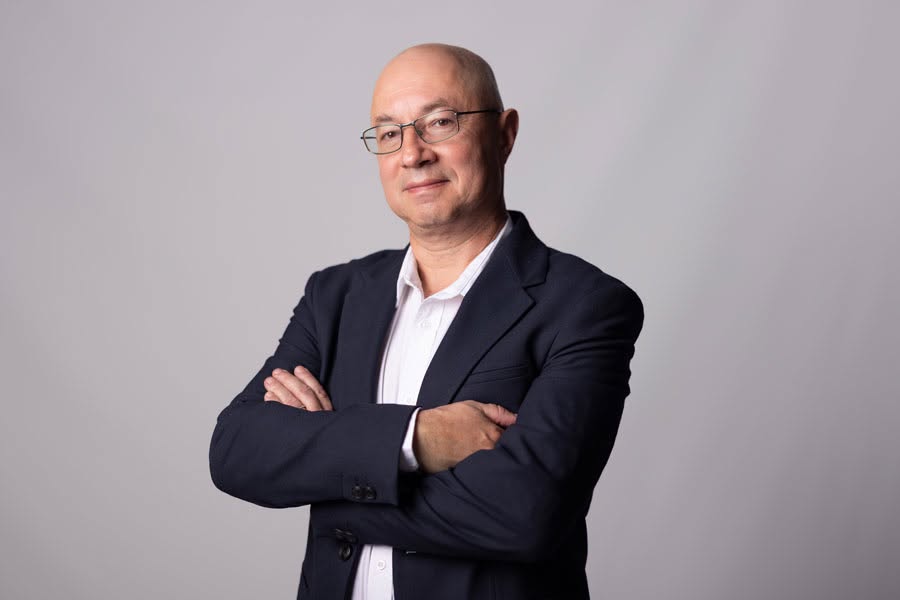
The Max Planck Institute for Software Systems mourns the passing of an extraordinary scientist, colleague, mentor, and friend.
It is with profound sadness that we announce the death of Professor Florian Luca, who passed away unexpectedly in late July 2026, in the midst of one of his regular research visits to the Institute in Saarbrücken. Florian -- Professor of Mathematics at Stellenbosch University and, since the start of the ERC Synergy project DynAMiCs in 2025, a part-time member of faculty at MPI-SWS -- was one of the world’s foremost number theorists, and over the past seven years had become an integral part of the scientific life of our Institute. His death is an immeasurable loss: to his family and friends, to mathematics and theoretical computer science, and to all of us who had the privilege of thinking alongside him.
Born in Galați, Romania, in 1969, Florian received his PhD from the University of Alaska Fairbanks in 1996, and went on to a career of rare geographic and intellectual breadth, holding positions at Syracuse University, Bielefeld University, the Czech Academy of Sciences, the National Autonomous University of Mexico, and the University of the Witwatersrand, before joining Stellenbosch University in 2024 -- together with visiting appointments at leading institutions around the world, including a Visiting Professorship in Oxford’s Department of Computer Science. One of the most prolific and versatile number theorists of his generation, he wrote more than 800 papers with hundreds of collaborators across dozens of countries, on Diophantine equations, arithmetic functions, linear recurrence sequences, and virtually every other corner of his subject. His distinctions included a Humboldt Research Fellowship, a Guggenheim Fellowship, two A1 ratings from South Africa’s National Research Foundation, Fellowship of the African Academy of Sciences, and an honorary doctorate from the University of Debrecen; he also served as editor-in-chief of Research in Number Theory and of INTEGERS. In addition, Florian was heavily involved in international collaborations, for example very recently as CNRS Fellow Ambassador and within the International Research Network GANDA (Geometry and Arithmetic), comprising members from France, South Africa, Denmark, and Madagascar. His mathematical legacy is vast, and it will rightly be recounted in detail elsewhere. Here we wish, above all, to speak of what Florian meant to us.
Florian’s association with MPI-SWS began in late 2019, when he started collaborating with the Foundations of Algorithmic Verification group. What was planned as a one-off visit became an annual fixture: from then on, Florian spent several months of every year in Saarbrücken, and his stays became a highlight of life in the group.
One of the group’s central research themes is the algorithmic analysis of discrete linear dynamical systems and related formalisms -- systems that are simple to describe but capable of extraordinarily intricate behaviour. They include linear loops and recurrence sequences, and arise throughout theoretical computer science, from program analysis and formal verification to automata theory and probabilistic model checking. The area’s most notorious open question is the Skolem Problem -- unresolved for many decades -- which asks whether one can decide if a linear recurrence sequence ever takes the value zero. Attempts to resolve it, and several related verification questions, repeatedly led to problems requiring deep number-theoretic insight. Florian arrived with a full arsenal, and his impact was nothing short of transformative, enabling us to make progress on a series of topics where no advances had been made for years if not decades. He helped weave automated verification, symbolic dynamics, and transcendence theory into a single fabric. It is given to very few to reshape a neighbouring discipline; Florian did so with evident joy, and made it look deceptively easy.
This partnership helped lay the scientific foundations for the award, in November 2024, of an ERC Synergy Grant -- among the most competitive research awards in Europe -- for the six-year project Dynamical and Arithmetical Model Checking (DynAMiCs), jointly led by Florian, Valérie Berthé of the CNRS (IRIF, Université Paris Cité), and Joël Ouaknine of MPI-SWS. The project brings together analytic number theory, symbolic dynamics, and algorithmic verification to tackle fundamental questions about discrete dynamical systems, including the Skolem Problem and the Pisot substitution conjecture. With the project’s launch, Florian formally joined MPI-SWS, enabling him to continue spending extended periods in Saarbrücken each year.
Florian was boundlessly generous -- with problems, with ideas, with credit, and above all with his time. Students and postdocs at the Institute found in him not a distant luminary but an eager collaborator and mentor, one who treated everyone as an equal partner in the hunt. For many of them, collaborating with Florian became a defining experience of their early careers. He seemed to carry an inexhaustible supply of open problems in one pocket and of stories in the other. He liked to say that “life is as interesting as you are willing to make it”, and he lived accordingly -- making the lives of everyone around him more interesting in the bargain. We will remember the marathon whiteboard sessions, the warmth, the humour, the ever-present smile.
We extend our deepest condolences to Florian’s family, and to his friends, students, and collaborators around the world -- not least our colleagues at Stellenbosch University and in the DynAMiCs project, who share this loss. The questions he helped us formulate, the methods he taught us to bring to them, and the joy with which he pursued them will continue to shape the work of MPI-SWS and DynAMiCs for many years to come.